Signed in as:
filler@godaddy.com
Signed in as:
filler@godaddy.com

Adolescence is not a problem to be fixed. It is a demanding developmental passage in which identity, relationships, emotion, judgement, independence and responsibility are all changing at once. Young people are expected to manage increasingly consequential choices, pressure, conflict and setbacks, yet they are not always given deliberate opportunities to practise the capabilities those demands require.
The Circle responds before difficulty becomes crisis. It creates a structured bridge between what young people are told about life and what they can learn to understand, test and apply for themselves. Its purpose is to accompany young people towards adulthood, helping them develop the character, judgement, confidence and practical capability to direct their own lives, build healthy relationships, accept responsibility and contribute to others.
The Circle is a two-stage developmental framework and modern rite of passage grounded in Strength, Honour and Compassion.
It focuses on capability rather than deficiency: young people are developing, not broken, and adulthood has no single correct shape. Trusted adults therefore guide without controlling, challenge without humiliating and support without removing every obstacle.
The method is relational and experiential. Small groups meet in a Circle where adults and young people exchange stories, questions and lived experience; explore realistic scenarios; learn through purposeful activity and challenge; and reflect on what happened. Adults do not present their experience as the answer. They offer it honestly as evidence that choices have consequences, people can learn, and difficulty can be navigated. Participants are encouraged to compare perspectives, exercise judgement and bring their own experience into the conversation without being forced to disclose.
The talking circle draws on a long human tradition of learning in community. Its recurring ritual establishes equality of attention, respectful listening, continuity and belonging. The practices may adapt to age, culture and setting, while the values, relational approach, participant agency and safeguarding boundaries remain consistent.
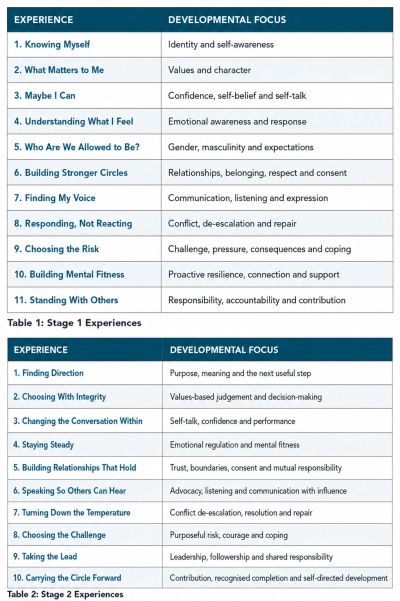
Stage 1 creates the foundation from which young people can begin navigating the transition towards adulthood deliberately. Its central question is: What do I need to understand and practise to become increasingly capable of directing my own life?
Delivery is structured but conversational through the introduction of the “Experiences” at Table 1. A trusted adult introduces ideas through stories and lived experience, invites participant questions, uses practical activities and fictional scenarios, and helps the group connect learning to real situations.
Stage 1 does not measure success by compliance or perfect behaviour. It seeks emerging self-awareness, language for difficult experiences, usable tools, confidence based on evidence, healthier judgement and a growing willingness to take responsibility, seek help and contribute. It provides the shared foundation on which deeper application can be built.
Stage 2 is not a repeat of Stage 1. It changes the developmental question from ‘Do I understand this?’ to ‘Can I use it when it matters?’ Participants return voluntarily to deepen the foundations through application, purposeful challenge, contribution and increasing ownership of their development.
Delivery is achieved through providing experiences at Table 2 and moves repeatedly between the Circle and life beyond it. Personal and group Quests give participants a continuing structure to choose or recognise a meaningful challenge, prepare, act, return, reflect, adapt and act again.
The trusted adult’s role evolves from providing substantial structure towards coaching, questioning, witnessing and appropriate challenge. While participants’ agency increases, the facilitator remains responsible for safety, dignity, boundaries and program integrity; increased agency does not mean transferring adult safeguarding duties to young people.
Stage 2 concludes with recognised transition into increasingly self-directed development. Formal participation ends, but belonging need not. Alumni may carry the principles privately into relationships, work and community life, or return—where appropriate and properly supported—as contributors, peer mentors or future facilitators.
Our Year 9 boys participated in the Full Circle pilot in 2025. The impact of this program has been incredible. We have seen a reduction in negative incidents, and an increase in positive relationships with staff and peers.
The boys are now able to listen to other perspectives and acknowledge the impact behaviour and words have on others. They are able to articulate values and demonstrate these through their improved behaviour, and connection to learning.
Michael is at the heart of this change, driving the program he has developed to deeply engage our young men. He is able to elicit their potential through activities that develop critical thinking, values clarification and self confidence.
Michael has been delivering programs to my school for many years now. I have been in the education system for the last 17 years and can say wholeheartedly that no one has ever delivered programs better then him. His authenticity, passion, and ability to engage and connect with students of all walks of life is second to none.
Michael has lived and experienced many things in his life and is always an open book to the students. He uses his own experiences (good and bad) to help guide some kids through difficult times or experiences they may be facing or currently going through. Michael delivers his message through power point presentations, group discussions, videos, games, and fun activities that get the kids engaged with one another all while building a positive rapport with the students.
We have never had a student pull out before the completion of the program, in fact we have had kids whom I’ve never had any dealings with come and ask me if they could join Michael’s programs as they have heard great things themselves from other students.
Personally after seeing how great Michael connects with the young people, I have reached out for him to mentor my own son who was going through a rough time. My son commented on how easy it was to talk with him and that he wished Michael ran programs in his school.
As a Youthworker in the ACT Public School system, it has been my pleasure sitting in on “The Circle”, a program created and led by Michael. Michael has a quiet confidence and charisma about him that is instantly captivating to the young men who are voluntarily participating in this program at our high school.
The students in our programs have individualised needs. Through his rich life experience and masterful self-reflections of very real and personal experiences, Michael manages to relate to and engage each of these young people in a way that I have not observed previously in their education journey. It is a genuine immersion based on mutual respect held by participants, for participants.
This connection is what allows for the program delivery and content to be so impactful. Concurrently as rapport is established, meaningful conversations are had amongst the circle about life, relationships, loss, trauma, values, safe pathways and positive masculinity - all in confidence. The structure of the lesson is dynamic, and Michael alters the delivery very naturally as the captivation of his audience peaks and wanes.
I haven’t had to propose any behaviour management strategies in the program at all. The responsibility of myself to the program doesn’t extend upon taking attendance and having Carer/guardian notes handed in. Therefore, I am also part of the circle program and feel that I learn from The Circle as a member of staff, and leave every session feeling refreshed.
Once again, a pleasure to observe and further take part in this program, and I implore any organisation considering working with Michael in The Circle take the summary of my experience as an uncompromising recommendation.
What did you like about the program?
* The program was perfect and would definitely do it again.
* I loved the program. I felt that I could open up.
* How it teaches to hold your values close and stand true to them.
* We talked about real world issues for men, and how the environment was welcoming, and we were all accepted and listened to.
* I liked everything but my favourite part was being with an array of different people because I usually struggle to talk to new people.
* The view of other people and Michael. The way it helped me view thing in another way and helped me with things.
* I liked how Michael let us speak about our feelings and he listened well and gave good advice.
* Michael explained topics easier than most people, making it (for me) easy to learn.
* I learned how to look deeper into myself and ask questions. Respect for myself and others.
We use cookies to analyze website traffic and optimize your website experience. By accepting our use of cookies, your data will be aggregated with all other user data.